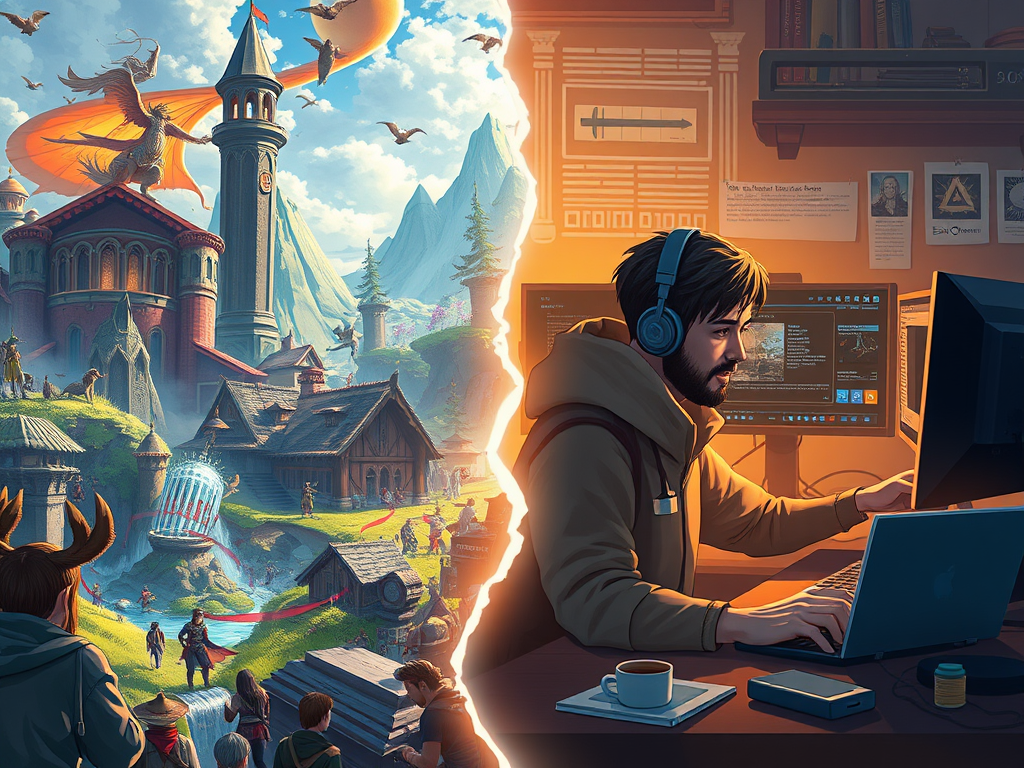
It’s been a while since I last posted here. Life, work, and all the usual busyness pulled me away, but I’ve missed writing. So here I am, back again. My plan is to post more regularly, and I thought I’d start with something that’s been on my mind for a while: what it’s like to go from being a player of games to someone who helps build them.
Growing Up as a Gamer
I loved all kinds of games growing up. At different points, I was completely hooked on Counter Strike, Final Fantasy XI, World of Warcraft… the list goes on. But if I had to pick a genre that really defined me, it was RPGs — probably jRPGs more specifically. The Final Fantasy series was my absolute favorite.
I still remember when I was deep into FFXI, I actually imagined myself working at SquareSoft (which eventually became Square Enix after the merger). I was spending all my free time in that game anyway, so I thought, “Why not get paid to be online?” Funny how that works.
As a pure gamer, I was all about immersion. Days blurred into nights, and I (unfortunately) skipped meals just to keep playing longer. Looking back, those were some of the most vivid experiences — completely losing myself in another world.
First Steps as a Builder
Fast forward to now, and my first real experience working on games was with Teamfight Tactics (TFT). I started out on backend services, and eventually worked on TFT Mobile, mostly around games.
That’s when I felt the scale of it all. I knew TFT was global, but it hit me differently once I was on the other side. You find yourself dealing with issues that only affect a small percentage of players worldwide, and the tricky part is: you often can’t replicate those issues yourself. Yet, they’re still critical to fix. That was a challenge, but also something I learned to appreciate.
Complexity Behind the Simplicity
As a player, the game always felt simple. You just jump in and play. But once you’re behind the curtain, you realize how much work goes into making that simplicity possible.
It’s not just code and servers — it’s scale, creativity, design, global distribution, and a team that never stops thinking about the player experience. I’m still blown away by how creative the TFT team is. Even now, there are aspects of game design I don’t fully understand, but I’ve learned to admire the artistry behind it.
How It Changed Me
Working on TFT has made me think about games differently. I can’t really play “innocently” anymore. Every time I pick up a game, I find myself wondering about the team behind it, the backend systems keeping it alive, and how they solve their toughest problems.
At work, I obsess over the little details. I think that comes from wanting to give players the best experience possible, because I know how much those details matter. Moving from player to builder has given me a new appreciation for quality games — I see the effort it takes to make them shine.
And outside of games, I catch myself applying those same lessons. Good practice patterns, attention to detail, thinking about edge cases — it’s funny how engineering habits bleed into the rest of life.
Talking to My Younger Self
If I could talk to my younger “just-a-player” self, I’d probably tell him to start jotting down those wild ideas he had while gaming for hours. Even though I wasted a lot of time grinding, I think those sessions shaped my curiosity and creativity. They nudged me toward the career I’m in today.
In a way, I’m closer to that dream I had back in the FFXI days — not working for Square Enix, but still building games that people around the world can enjoy. And that’s something my younger self would’ve been proud of.
Closing Thoughts
So that’s been my journey: from immersion as a player, to tackling complexity as a builder, to having a deeper appreciation for what makes games great.
Thanks for sticking with me through this long post — and through my long break from writing. I’m excited to share more stories, thoughts, and lessons here.
Let me leave you with a question: Has a hobby ever changed for you once you saw the work behind it?
 johnro
Leave a comment